
Leakage current can leave a live conductor through damaged insulation, moisture, an appliance casing, or a person, without creating the high current needed to trip an MCB. You will learn how an RCCB detects that imbalance, how to specify and install one correctly, and where additional protection remains necessary.
Key takeaways
- An RCCB trips when outgoing and returning current differ by its IΔn rating.
- IΔn protects against earth leakage; In does not replace overload protection.
- Choose poles, Type AC or Type A detection, and ratings for the circuit.
- Repeated trips require isolation, insulation testing, and inspection of connected equipment.
How leakage current creates an RCCB trip
Leakage current is unintended current flowing from a live conductor to earth or another conductive path instead of returning through the circuit conductors. Damaged insulation, moisture and wet equipment can create that path; a person touching an energised part can also become part of it.
An RCCB compares the current entering a circuit with the current returning from it. Line and neutral pass through the device’s residual-current transformer in a single-phase circuit. If current leaves through protective earth, equipment metalwork, or a person, the returning current is smaller, creating a residual imbalance.
That imbalance operates the RCCB’s trip mechanism. When the residual current reaches or exceeds the device’s rated residual operating current, IΔn, the mechanism releases its contacts and disconnects the circuit. A 30 mA RCCB is intended to provide additional protection against electric shock, but 30 mA is not a guaranteed shock-safe threshold.
It is also not intended to trip at residual current at or below 15 mA, which is 0.5 times its rating. The separate rated current, In, states how much load current the device can carry; it does not set the leakage-current trip point.
IΔn, In, and the protection an RCCB does not provide
30 mA identifies an RCCB’s residual operating sensitivity, not the load it can carry. IΔn is the residual current that causes operation; In is the continuous current rating of the device. A 30 mA RCCB is therefore not automatically suitable for every circuit.
| Marking or device | What it measures or protects | What it does not provide |
|---|---|---|
| IΔn | Leakage or residual current, such as 30 mA | Overload or short-circuit protection |
| In | Continuous load current through the RCCB | A residual-current trip threshold |
| MCB or fuse | Excess current from overloads and short circuits | Sensitive protection against leakage to earth |
| RCBO | Combines residual-current and overcurrent protection | Protection beyond its specified ratings |
RCCB versus MCB is not an either-or choice: the RCCB detects imbalance, while the MCB or fuse limits dangerous current in the conductors. If a load exceeds In or a short circuit occurs, an unprotected RCCB can overheat or fail before disconnecting.
Install an appropriately rated MCB or fuse upstream or downstream as the design requires.
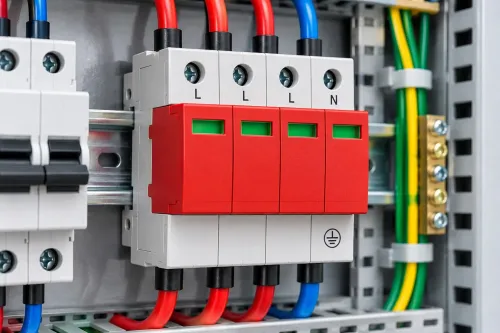
An SPD handles transient overvoltage, not ordinary leakage or sustained overload. It does not replace an RCCB, MCB, or fuse; coordinate its required backup overcurrent protection with the manufacturer’s instructions.
Selecting poles, wiring, and RCCB detection type
Match the RCCB poles to every live conductor supplying the circuit: use a 2-pole device for single-phase and a 4-pole device for three-phase with neutral. A three-phase, three-wire load can use a 3-pole RCCB only when the device manufacturer permits it.
Route line and neutral routing through the sensing core together. For three-phase circuits, pass all three phases and the neutral through it; otherwise normal load current appears as leakage and causes trips. Keep the protective-earth conductor outside the core, and never switch a TN-C PEN conductor through the RCCB.
Separate PE and neutral first, following the installation rules.
Choose detection from the residual waveform the load can create.
| Type | Detects | Select it for |
|---|---|---|
| Type AC | Sinusoidal AC residual current | Simple AC loads with no specified electronic-current requirement |
| Type A | AC plus pulsating DC residual current | Electronic rectifiers, appliances with switch-mode supplies, and similar single-phase equipment |
| Type F | AC, pulsating DC, and mixed-frequency residual current | Single-phase variable-speed drives and equipment whose manufacturer specifies mixed-frequency detection |
| Type B | AC, pulsating DC, mixed-frequency, and smooth DC residual current | A PV inverter, EV charger, variable-speed drive, or converter capable of smooth DC leakage |
Do not install Type AC upstream of power electronics that can produce smooth DC residual current; DC can bias its sensing element and block operation during an AC fault. Follow the equipment manufacturer’s specified RCD type over a choice based only on voltage or current.
Coordinating ratings, fault protection, and selective disconnection
Match the RCCB’s rated voltage and frequency to the supply, then choose a rated current at or above the circuit’s continuous load. An RCCB does not clear overloads or short circuits, so an MCB or fuse must provide overcurrent protection.
Check the conditional short-circuit rating Icn or Inc where specified by the product documentation, and confirm that the upstream fuse or MCB limits prospective fault current to that value. Without this coordination, a fault can destroy the RCCB before it disconnects.
Suitability also depends on the earthing arrangement, protective-conductor impedance, earth-fault loop result, and required disconnection time under the applicable national implementation of IEC 60364. A 30 mA residual threshold is not a guaranteed safe touch-voltage limit.
For selective disconnection, verify:
- The downstream RCCB has the lower residual operating threshold and can clear the fault first.
- The upstream device has compatible residual-current ratings and, where required, time delay.
- Circuit leakage remains below the device’s operating range; divide circuits when filters, long cables, inverters, or LED drivers create accumulated leakage.
A higher upstream ampere rating alone does not provide selectivity. Without coordination, one local fault can disconnect an entire distribution section.
Installing, testing, and investigating repeated trips
Before energising, confirm that the supply and outgoing conductors use the marked line/load terminals, not assumptions based on physical position. Route every line and associated neutral through the sensing core; keep protective-earth conductors outside it, and never interrupt a TN-C PEN conductor.
Apply the manufacturer torque, check conductor size, confirm neutral separation, and verify the enclosure rating suits the installation environment.
- Check that no downstream neutral-to-earth bond exists and that neutrals are not shared between circuits protected by different RCCBs.
- Press the TEST button with the circuit energised; the device must trip and the handle must reset correctly.
- Complete continuity, insulation-resistance testing, and fault-loop tests required by the governing installation standard. The TEST button does not prove earth-conductor, bonding, or earth-electrode performance.
- Record trip time and residual-current results during leakage-current testing, then compare them with the device specification.
- If trips recur, disconnect outgoing circuits and reconnect them one at a time; inspect the failing circuit for moisture, damaged insulation, appliances, long cables, filters, inverters, and surge suppressors.
- Measure standing leakage with a suitable clamp meter, including neutral and protective-earth paths, and repair or divide circuits when accumulated leakage is excessive.
Never replace a 30 mA RCCB with a higher residual rating merely to stop nuisance trips. Find the leakage source first.
Deciding whether an RCCB is enough for the circuit
An RCCB is the wrong sole protection where the hazard is a line-to-neutral contact: current can leave through a person and return on neutral without creating enough imbalance.
It also does not detect overloads, short circuits, or every dangerous arc; add an MCB, or choose an RCBO, and consider an AFDD where the local wiring code calls for arc-fault detection. An SPD provides overvoltage protection, not residual-current protection.
Use this practical checklist before buying or retrofitting:
- Confirm the earthing arrangement, earth-fault loop result, disconnection time, conductor sizes, and touch-voltage limits against the local wiring code and IEC 60364.
- Match the device to supply poles, frequency, voltage, load current, short-circuit rating, and detection type; verify IEC 61008-1 for an RCCB or IEC 61009-1 for an RCBO.
- Ask for supplier evidence: test reports, declaration of conformity, ratings, terminal diagrams, and compatible upstream overcurrent protection. Yueqing Growmore Electric Co can be asked for this evidence before selection.
- Price retrofit labour cost for rewiring shared neutrals, separating PEN conductors, testing protective conductors, and verifying insulation and loop performance—not just the device.
Related product
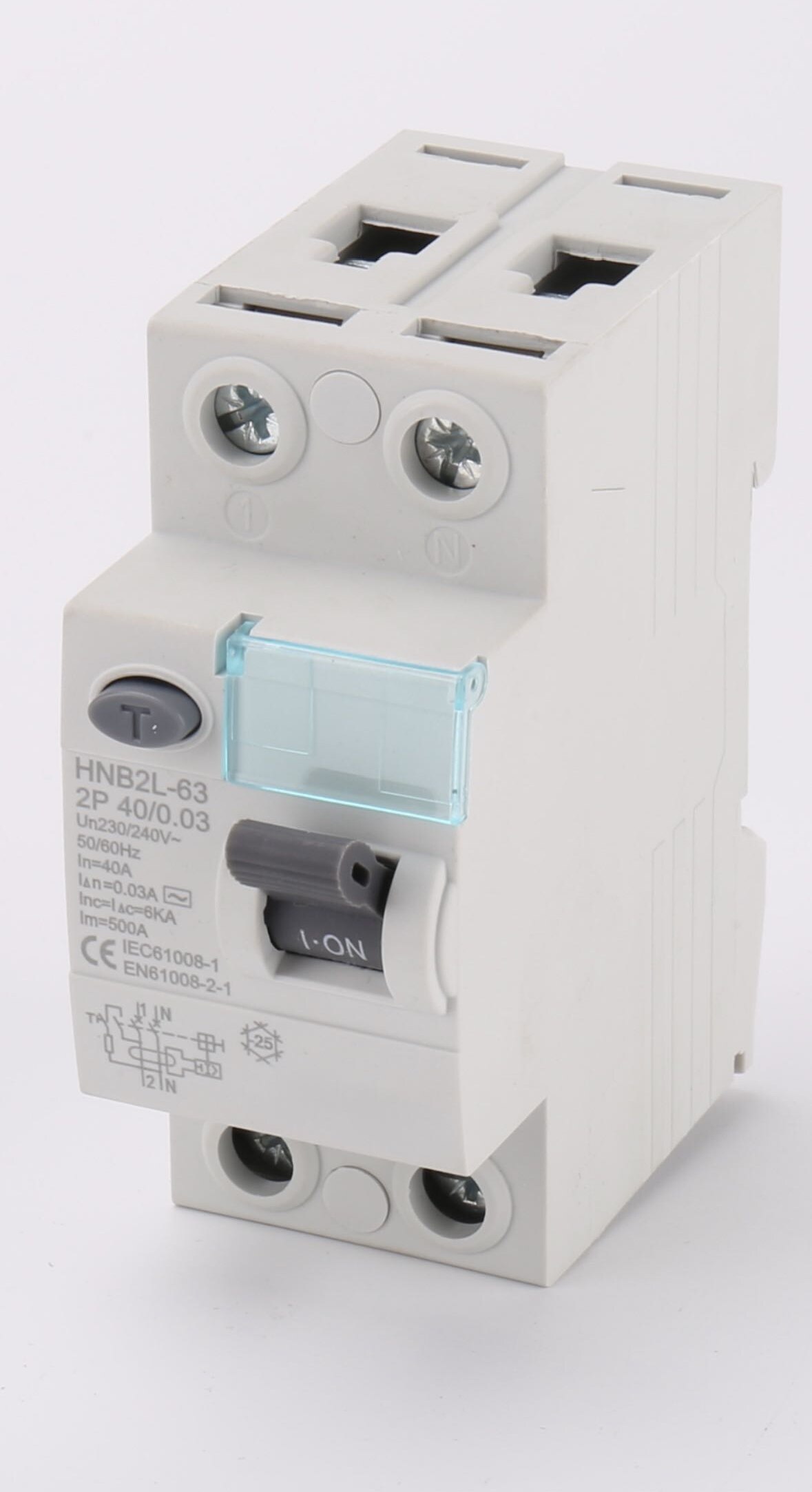 | Contactors & RCCB RCCB Yueqing Growmore Electric Co., Ltd. - Advanced RCCB Solutions for Safety and Protection Company Overview At Yueqing Growmore Electric Co., Ltd., we... |
Frequently asked questions
How does leakage current create an RCCB trip?
An RCCB compares current leaving through the live conductors with current returning through them. A difference flowing to earth exceeds IΔn, causing the device to disconnect.
What do IΔn and In mean on an RCCB?
IΔn is the rated residual operating current, such as 30 mA. In is the rated current the RCCB can carry continuously; neither rating provides overload or short-circuit protection.
Which RCCB detection type should you choose?
Type AC detects sinusoidal alternating residual current. Type A also detects pulsating direct residual current from electronic loads, so check the equipment manufacturer’s requirement before selecting.
What should you do when an RCCB trips repeatedly?
Disconnect downstream circuits and reconnect them one at a time. If one circuit causes the trip, isolate its appliances and have a qualified electrician inspect insulation, moisture, neutral-earth faults, and wiring.
Is an RCCB enough protection for a circuit?
No. Pair it with an overcurrent protective device such as an MCB or fuse, and confirm earthing, conductor sizing, breaking capacity, and coordination before energising the circuit.