An aluminium cable landing on a copper busbar, breaker terminal, or switchgear pad needs more than a lug with the right hole: the conductor barrel and equipment-facing palm must each suit their materials. By the end, you will be able to identify the transition point, compare connector types, verify the product and crimp system, and reject an unsafe or undocumented choice.
Key takeaways
- Use a bimetallic lug where aluminium cable terminates on copper equipment.
- Confirm the lug fits the conductor, terminal pad, and governing standard.
- Install the lug, die, connector, and tooling as one matched compression system.
- Choose another termination when the equipment is not approved for aluminium conductors.
Identify the aluminium-to-copper transition point before choosing a lug
The transition point is the first metal-to-metal termination after the aluminium cable. If it lands on a copper busbar, copper terminal, copper switchgear pad, or copper-alloy connection, choose a bimetallic lug unless the complete terminal is listed for aluminium and its instructions allow it.
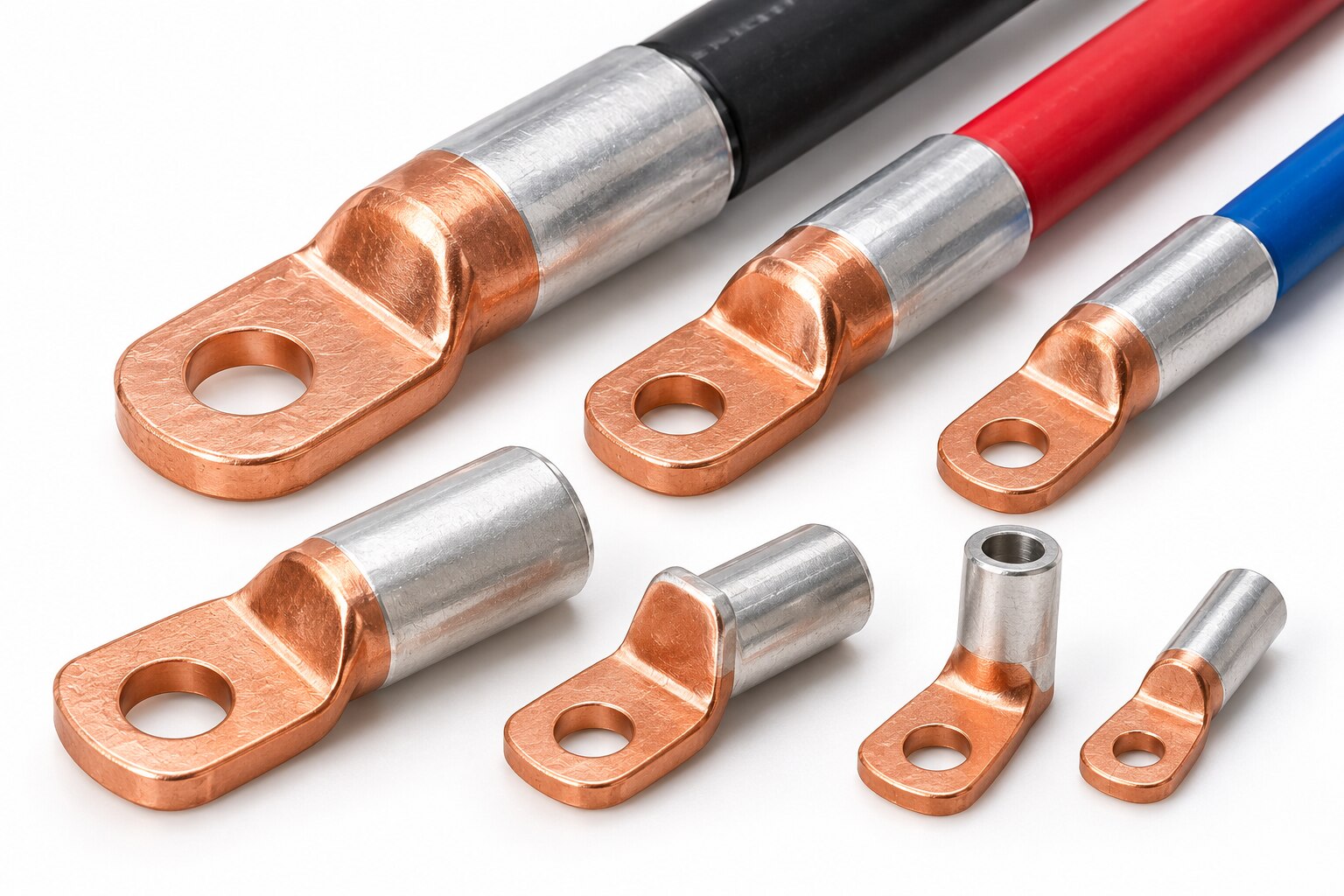
Its aluminium barrel grips the conductor; its copper palm meets the equipment through a friction-welded joint.
| Interface | Connector decision | Failure risk controlled |
|---|---|---|
| Aluminium cable to copper busbar | Use a bimetallic lug | Limits direct aluminium-to-copper contact, oxide formation, and galvanic corrosion |
| Aluminium cable to copper terminal | Use a bimetallic lug unless the terminal is aluminium-listed | Controls contact resistance, local heating, and thermal-cycle loosening |
| Aluminium cable to an aluminium-listed terminal | Follow the terminal instructions | Avoids adding an unnecessary transition connector |
| Copper cable to copper equipment | Use an all-copper termination | A bimetallic lug adds no useful transition |
The lug is not a cure for poor geometry. Check palm hole, palm thickness, stud size, orientation, clearance, washer arrangement, and specified torque; “tight by feel” is not controlled. Ampacity still comes from the cable, terminal, temperature rating, and installation conditions. Moisture, salt, or pollution still demands specified sealing and corrosion control.
Know what a bimetallic lug is—and what it does not replace
A bimetallic lug terminates an aluminium conductor on a copper busbar, breaker terminal, switchgear pad, or copper-alloy equipment terminal. Its friction-welded aluminium barrel accepts the conductor; its copper palm meets the equipment. The welded transition limits oxide, galvanic-corrosion, contact-resistance, heating, and thermal-cycling problems at a direct aluminium-to-copper joint.
| Device | Construction | What it does, or does not replace |
|---|---|---|
| Bimetallic lug | Aluminium barrel and copper palm | Provides one aluminium-to-copper termination; it does not fix a wrong hole, pad, bolt stack-up, or cable size |
| standard aluminium lug | Aluminium barrel and palm | Terminates aluminium onto compatible aluminium equipment; it is not a copper-busbar transition |
| standard copper lug | Copper barrel and palm | Terminates copper conductors; tin plating alone does not make it suitable for aluminium |
| Bi-metallic washer | Dissimilar-metal washer between surfaces | Helps separate or bridge metals at a bolted joint; it does not provide a conductor barrel or compression termination |
| Transition splice | Joined cable-to-cable connector | Changes conductor material along a cable run; it does not mount the cable to equipment |
| Mechanical dual-metal connector | Set-screw or shear-bolt body rated for both metals | Offers a mechanical termination when listed; it is not interchangeable with a compression lug |
Select the connector for the conductor material, stranded or solid construction, cross-sectional area in mm² or AWG/kcmil, stud size, palm-hole diameter, palm geometry, barrel length, and available clearance. Check AL/CU marking and the applicable listing, such as UL 486A-486B or IEC 61238-1-1; never infer ampacity from either metal.
Match the lug to the conductor, terminal, and governing standard
A lug marked only CU is not suitable for aluminium cable, even when its palm fits the terminal. Match the connector to the conductor material, construction, and size: confirm aluminium compatibility, stranded or solid construction, conductor cross-sectional area in mm², and the stated AWG or kcmil range.
- Check the barrel length and internal diameter against the stripped cable, not just its nominal size.
- Measure the terminal: palm-hole diameter, stud size, palm thickness, palm geometry, bolt grade, orientation, and available clearance must match the equipment pad.
- Confirm the lug’s temperature rating is suitable for the cable, terminal, and installation conditions. The lug’s copper palm or aluminium barrel does not establish ampacity; cable ampacity and the equipment terminal rating do.
- Request the manufacturer’s installation instructions, crimp-die requirement, and test or listing documents. Yueqing Growmore Electric Co can be asked for these selection details rather than relying on a catalogue title alone.
| Evidence | Accept | Reject |
|---|---|---|
| Conductor marking | AL/CU or equivalent, with the actual aluminium and copper connection covered | “Tin-plated copper” without aluminium approval |
| North American approval | UL 486A-486B listing covering the connector and conductor materials | A general claim of electrical-grade material |
| IEC project evidence | IEC 61238-1-1 test or certification for the specified connector type | “For aluminium cable” with no test document |
| Terminal fit | Correct hole, stud, palm thickness, bolt stack-up, and clearance | A palm that fits but prevents specified clamping force |
| Cable range | Actual cross-sectional area, AWG, or kcmil falls inside the marked range | Size inferred from barrel appearance |
Related product
 | Cable Accessories YUEQING GROWMORE ELECTRIC CO., LTD. is a leading manufacturer and supplier of high-quality bimetallic lugs for electrical connections. View product → |
Install the compression system as a matched set
Treat the lug, conductor, crimp tool, crimp die, and installation instructions as one system. Strip only the specified length; excessive stripping leaves an unsupported section that can flex and heat. Remove aluminium oxide with the approved tool, then apply the specified joint compound or inhibitor before the conductor enters the barrel.
- Confirm the lug accepts the conductor’s class, strand construction, size, and shape. A barrel intended for compact aluminium cable is not automatically suitable for non-compact or sector cable.
- Use the listed tool and die family, including the exact die code and hex crimp profile. Follow the stated number, position, and sequence of crimps; a complete-looking indentation with the wrong die remains an invalid connection.
- Insert the conductor fully to the barrel stop without folded strands or exposed gaps. Keep compound off the palm and terminal contact surfaces.
- Clean and flatten the palm and mating terminal, then install the specified washer arrangement. Check the palm hole, bolt grade, orientation, and clearance before tightening.
- Apply the equipment or lug manufacturer’s torque with a calibrated torque tool. “Tight by feel” cannot establish the required clamping force.
Inspect every crimp for the correct marks, spacing, and die code, and check that no strands are cut, cracked, or pushed outside the barrel. Verify full conductor insertion and record the applied torque. A final visual check cannot rescue an under-crimp, loose bolt, wrong barrel, or a joint compound used in place of proper preparation.
Decide when another termination is the better choice
Use the equipment terminal itself when it is listed for the conductor material, size, and temperature rating. Adding a bimetallic lug to an aluminium-rated terminal adds a joint without solving a problem.
| Option | Choose it when | Reject it when |
|---|---|---|
| Listed equipment terminal | The breaker, busbar clamp, or switchgear terminal is marked for aluminium or dual-rated conductors, and you follow its torque and preparation instructions. | The terminal is copper-only, or its conductor range and temperature rating do not match. |
| All-copper lug | The conductor is copper and lands on a copper terminal, busbar, or pad. | The conductor is aluminium; a copper barrel does not make it aluminium-compatible. |
| Mechanical connector | The connector is specifically listed for the aluminium-to-copper combination, conductor construction, size, and installation method. | You are relying on a generic clamp, an unmarked connector, or a connector outside its listed temperature rating. |
| No connector | The conductor enters a listed terminal directly, with no copper-to-aluminium transition outside the terminal. | You would be clamping aluminium directly to a copper-only surface. |
For North American work, look for a connector evaluated under UL 486A-486B; IEC 61238-1-1 is a relevant reference for power-cable compression and mechanical connectors. Do not substitute a copper-only lug because its palm fits.
Select a bimetallic lug instead when aluminium cable must land on a copper busbar or copper equipment pad. In damp, coastal, polluted, or buried locations, also address sealing and plating: the transition does not eliminate galvanic corrosion, oxide growth, thermal cycling, or loosening.
Frequently asked questions
Where should you identify the aluminium-to-copper transition point?
Find the first metal-to-metal termination after the aluminium cable. If it lands on a copper busbar, copper terminal, copper switchgear pad, or copper-alloy connection, assess a bimetallic lug unless the complete terminal is listed for aluminium.
What does a bimetallic lug do?
A bimetallic lug provides an aluminium conductor barrel joined to a copper palm, creating a compatible interface between an aluminium cable and copper equipment. It does not replace correct cable preparation, torque control, or terminal approval.
How do you match a bimetallic lug to an installation?
Match the lug to the conductor material and size, terminal dimensions, installation method, and governing standard. Check the manufacturer’s markings, approved conductor range, palm-hole size, temperature rating, and required compression die.
Why must the compression system be installed as a matched set?
Use the lug, connector, die, crimping tool, and compression sequence specified together by the manufacturer. A visually complete crimp can still fail when the die profile or tool does not match the lug.
When is a bimetallic lug the wrong choice?
Choose another termination when the equipment is not approved for aluminium, the lug cannot match the conductor or terminal, the required tooling is unavailable, or the installation instructions specify a different connection system.