A surge is not the same as a sustained high or low voltage: the first is a fast transient, while the second requires regulation or disconnection. By the end, you will know where AC- and DC-side SPDs belong, how to verify their ratings for a photovoltaic array, and which hazards they cannot solve.
Key takeaways
- Install DC SPDs near the PV array and inverter where cable runs create exposure.
- Use AC SPDs at the inverter output and main distribution board.
- Match the SPD’s UCPV, Uc, In, and Imax ratings to the system.
- An SPD limits transient voltage; fuses, breakers, and RCDs handle other faults.
What a surge is—and why solar equipment has more entry points
A transient is a short-lived surge of voltage or current, often lasting microseconds to milliseconds. Lightning and utility switching can create it, and the resulting spike can puncture insulation or damage inverter semiconductors before protective equipment reacts.
That differs from an ordinary power-quality problem such as sustained overvoltage or undervoltage. A sustained overvoltage lasts for many cycles or longer, so it can overheat a varistor and stress equipment continuously; a transient is brief but far more abrupt.
An SPD diverts the transient and limits the residual voltage reaching downstream equipment—it does not correct the supply voltage itself.
Photovoltaic systems have extra entry points because their generating equipment sits outdoors and connects several electrical zones across long cable runs:
- Rooftop modules and exposed metalwork can receive a direct lightning strike or pick up an induced lightning pulse without a direct strike.
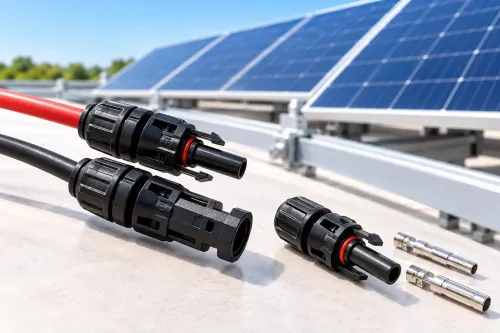
- Long DC cables between the array, combiner box and inverter behave as conductors that can carry the induced transient into the building.
- The inverter’s AC output provides another route from the installation’s distribution board or utility connection.
A single SPD at the inverter does not necessarily protect a long PV cable run. Substantial distance between the array and inverter can require protection at both DC ends, while the AC side needs protection near the inverter and building distribution equipment.
Good bonding and short, low-impedance connections determine how much of the surge reaches the equipment.
Where DC- and AC-side SPDs belong in a PV installation
The inverter is not a shield for the cable behind it. A long run between the PV modules and inverter can pick up an induced lightning transient, so a single DC-side SPD beside the inverter may leave the array-side cable exposed.
Position protection at these points:
- At the array or combiner box, install a DC-side SPD where the string circuits enter the combiner or where the array cable leaves the field.
- At the inverter’s DC terminals, add a second DC-side SPD when the cable run from the array or combiner box is substantial. This limits the surge entering the inverter from either direction.
- On the inverter’s AC output, install an AC-side SPD close to the inverter or at the adjacent AC distribution point.
- At the main distribution board or service entrance, install AC protection for the building wiring and the route toward the utility connection. Coordinate this device with any upstream utility or lightning protection.
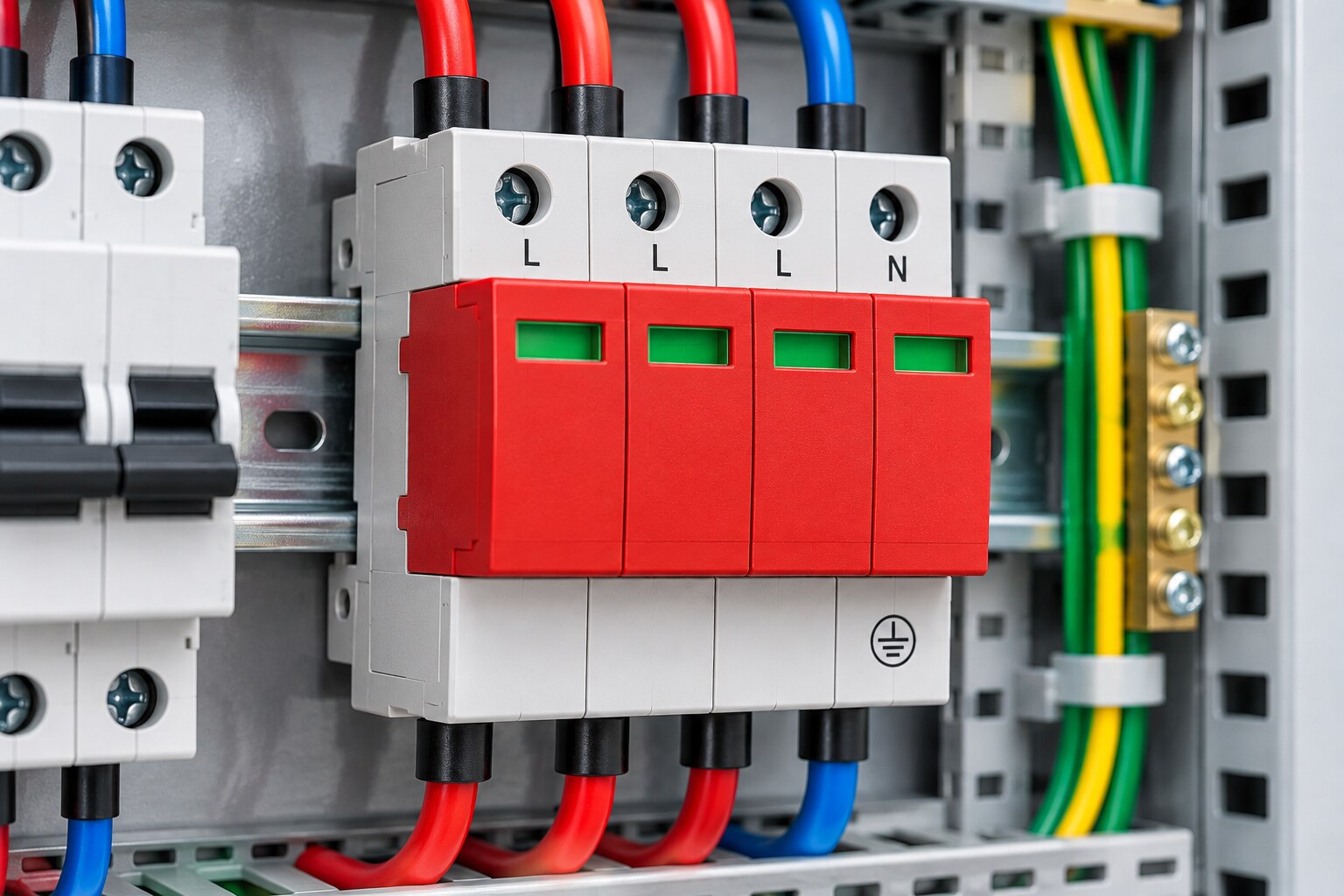
Keep each SPD’s phase, neutral, protective-earth, and bonding conductors short and straight. The total connection path, including the outgoing and bonding conductors, should be about 0.5 m where practicable; extra length adds inductive voltage during a fast surge.
Bond the SPDs to the same low-impedance earthing system used by the installation. Check that the SPD’s voltage-protection level, Up, remains below the impulse withstand rating of the inverter, board, and connected equipment after wiring inductance is included. Poor bonding can turn a protective connection into a flashover path.
How IEC 61643 standards determine the right SPD type
Type selection depends on the surge duty at the installation point, not on inverter size. For AC circuits, IEC 61643-11 defines Type 1 for partial lightning-current duty, tested with a 10/350 µs impulse, and Type 2 for switching and induced-surge duty, tested mainly with an 8/20 µs waveform.
A Type 1+2 device combines both duties at one location.
| Type | What it handles | When it applies |
|---|---|---|
| Type 1 | Partial lightning current | At the service entrance when an external lightning protection system or overhead supply can conduct lightning current |
| Type 2 | Induced lightning and switching surges | At distribution boards and downstream points without a Type 1 requirement |
| Type 1+2 | Both test duties in one device | Where the installation point needs Type 1 and Type 2 protection without separate coordinated units |
Do not apply an AC rating to the PV side. A photovoltaic DC SPD must comply with IEC 61643-31, and its Ucpv must exceed the string’s maximum open-circuit voltage calculated at the site’s lowest design temperature.
Check its PV short-circuit-current capability and discharge ratings as well: In, Imax, and Iimp describe different test duties, so a large Imax value does not prove Type 1 suitability.
Coordinate the SPD’s Up with the protected equipment’s impulse withstand voltage, including wiring voltage drop and inductance. Also verify the manufacturer’s maximum backup fuse or breaker, prospective short-circuit current, and coordination data; the upstream circuit breaker is not automatically an acceptable backup device.
How to check voltage, current, and wiring compatibility before installation
The figures that prove an SPD fits are the array’s cold-weather open-circuit voltage, short-circuit current, system earthing arrangement, and the protected equipment’s impulse withstand voltage—not the inverter’s headline rating.
| Figure or check | Compare it with | Why it matters |
|---|---|---|
| Ucpv | Maximum string Voc calculated at the site’s lowest design temperature | Cold crystalline-silicon modules produce higher Voc; Ucpv must exceed that value. |
| Uc | The actual DC or AC system voltage and earthing configuration | A mismatched Uc causes continuous stress or leaves the SPD inactive during a fault. |
| In and Imax | The installation’s expected surge duty and the manufacturer’s test data | In is the nominal discharge-current duty; Imax is the maximum discharge-current duty. Neither replaces Iimp where partial lightning current can enter. |
| Up | The inverter, module, and distribution equipment’s impulse withstand voltage | Excessive residual voltage still damages equipment, even when Uc is correct. |
| PV short-circuit current | The SPD’s short-circuit withstand rating and specified backup fuse or MCB | A PV DC arc does not naturally extinguish at current zero, so an AC device with the same voltage label is unsafe. |
Use a PV-specific device assessed to IEC 61643-31, with DC isolation and thermal disconnection. Confirm polarity, number of poles, conductor size, terminal range, and the manufacturer’s maximum lead length; long, looping conductors add inductive voltage.
Yueqing Growmore Electric Co can be asked for a datasheet that states Ucpv, Uc, In, Imax, Up, short-circuit withstand, backup protection, and terminal limits together. If those figures are absent, the product has not proved compatibility.
Related product
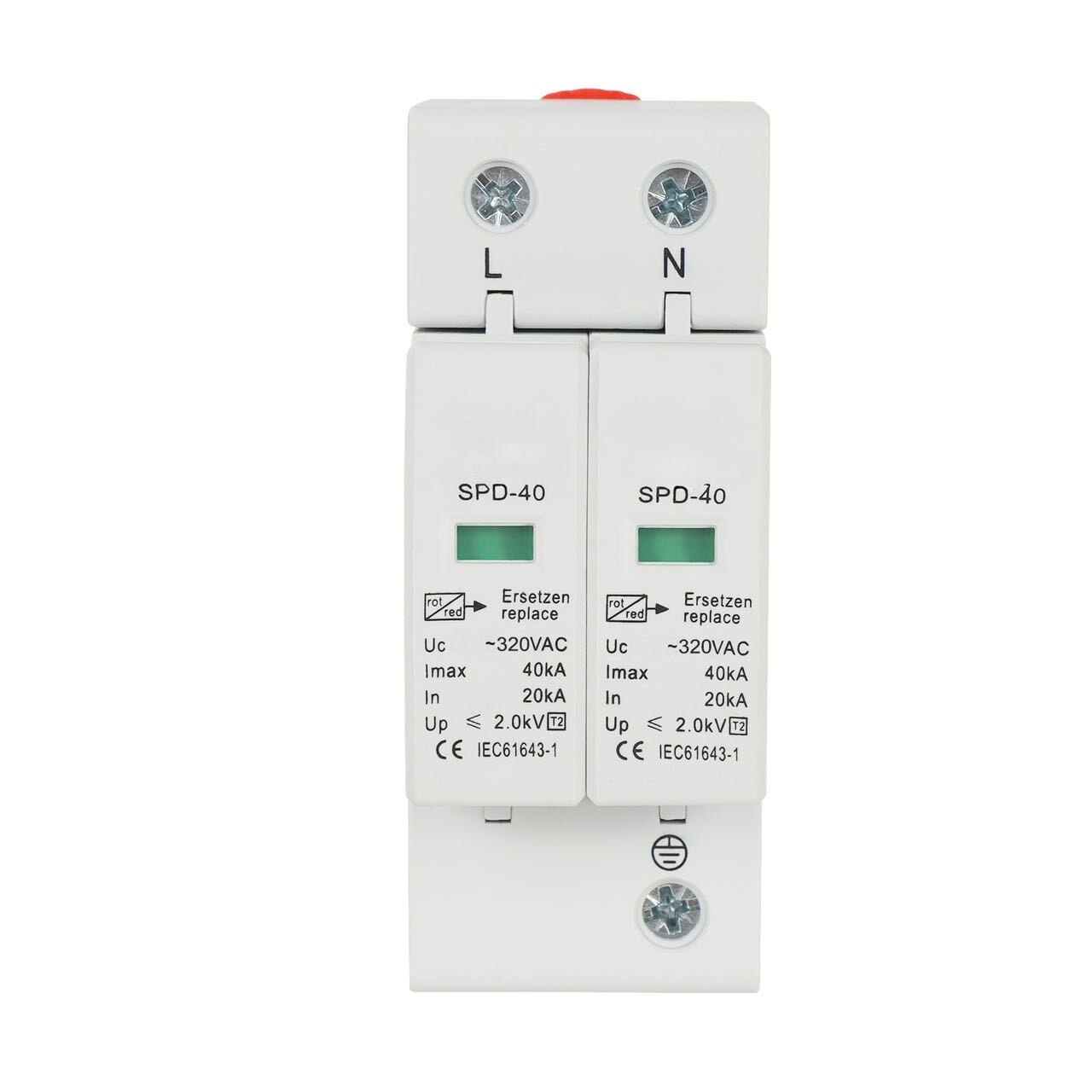 | Solar Accessories Yueqing Growmore Electric Co., Ltd. - Protect Your Electrical Systems with Advanced Surge Protection Devices (SPD) Company Overview Yueqing Growmore... View product → |
What an SPD protects—and what still needs a different device
An SPD diverts surge current and limits the residual voltage, Up, reaching equipment; it does not remove the surge or correct sustained overvoltage. Its bonding conductor must connect to a low-impedance earthing system.
Keep the combined line, neutral, and bonding conductors as short as practicable—about 0.5 m total—because inductive voltage in long wires can leave a closely rated device ineffective.
An SPD also needs correctly coordinated backup protection. Check the manufacturer’s maximum backup fuse or MCB rating, the prospective short-circuit current, and the device’s short-circuit current rating (SCCR). An upstream breaker is not automatically suitable; an SPD fault without the specified disconnection path can damage the board.
Inspect status indicators, thermal disconnects, terminals, and wiring after faults, lightning events, or alterations. On PV DC circuits, use a device compliant with IEC 61643-31, with DC isolation and arc-interruption characteristics—not an AC SPD with a similar voltage label.
Use this checklist to match the protection to the fault:
- Choose a voltage protector for sustained overvoltage or undervoltage, not a microsecond surge.
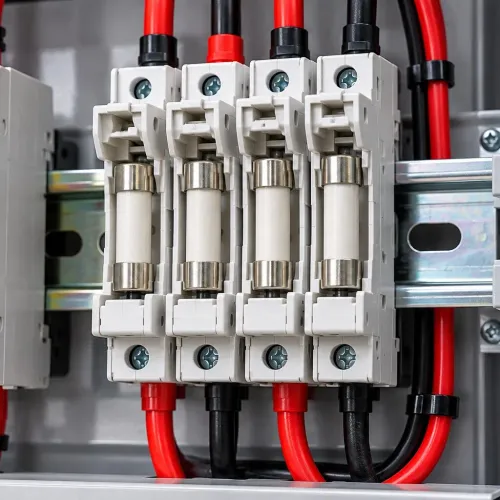
- Choose a fuse for defined overcurrent protection and high fault-current interruption.
- Choose an MCB for resettable overload and short-circuit protection within its curve and breaking capacity.
- Choose an RCCB for earth-leakage and shock protection; it does not replace overcurrent protection.
- Choose a UPS when equipment needs uninterrupted, conditioned power during outages or voltage dips.
Lightning bonding, separation distances, and conductor routing remain necessary. An SPD cannot safely compensate for a poorly bonded lightning-current path.
Frequently asked questions
Where do DC and AC SPDs belong in a PV installation?
Place DC SPDs near the PV array and inverter, and AC SPDs at the inverter output and main distribution board. Keep connecting conductors short and follow the manufacturer’s wiring diagram.
How does IEC 61643 determine the correct SPD type?
IEC 61643-31 covers SPDs for photovoltaic installations, while IEC 61643-11 covers low-voltage AC systems. Type 1, Type 2, or Type 1+2 selection depends on lightning exposure, the site’s protection system, and the installation point.
Which SPD ratings must you check before installation?
Check the DC maximum continuous operating voltage UCPV, AC maximum continuous operating voltage Uc, nominal discharge current In, maximum discharge current Imax, short-circuit rating, pole configuration, and conductor compatibility.
What does an SPD protect, and what does it not replace?
An SPD diverts transient overvoltage to limit stress on inverters, cables, and connected equipment. It does not replace overcurrent protection, isolation switches, fuses, circuit breakers, RCDs, grounding, or lightning protection.