Loose strands can fold back, escape a terminal clamp, or bridge into adjacent connection points when you terminate flexible wire. By the end, you will know how a ferrule contains those strands, which terminals accept one, how to size it, and how to inspect the finished crimp.
Key takeaways
- Ferrules gather stranded wires into one controlled end for clamping.
- Match ferrule barrel size to the conductor’s actual cross-sectional area.
- Use a ferrule-specific crimper, not pliers or a generic terminal crimper.
- Reject ferrules with damaged collars, loose barrels, or incomplete crimps.
What an End Sleeve Ferrule Changes at the Wire End
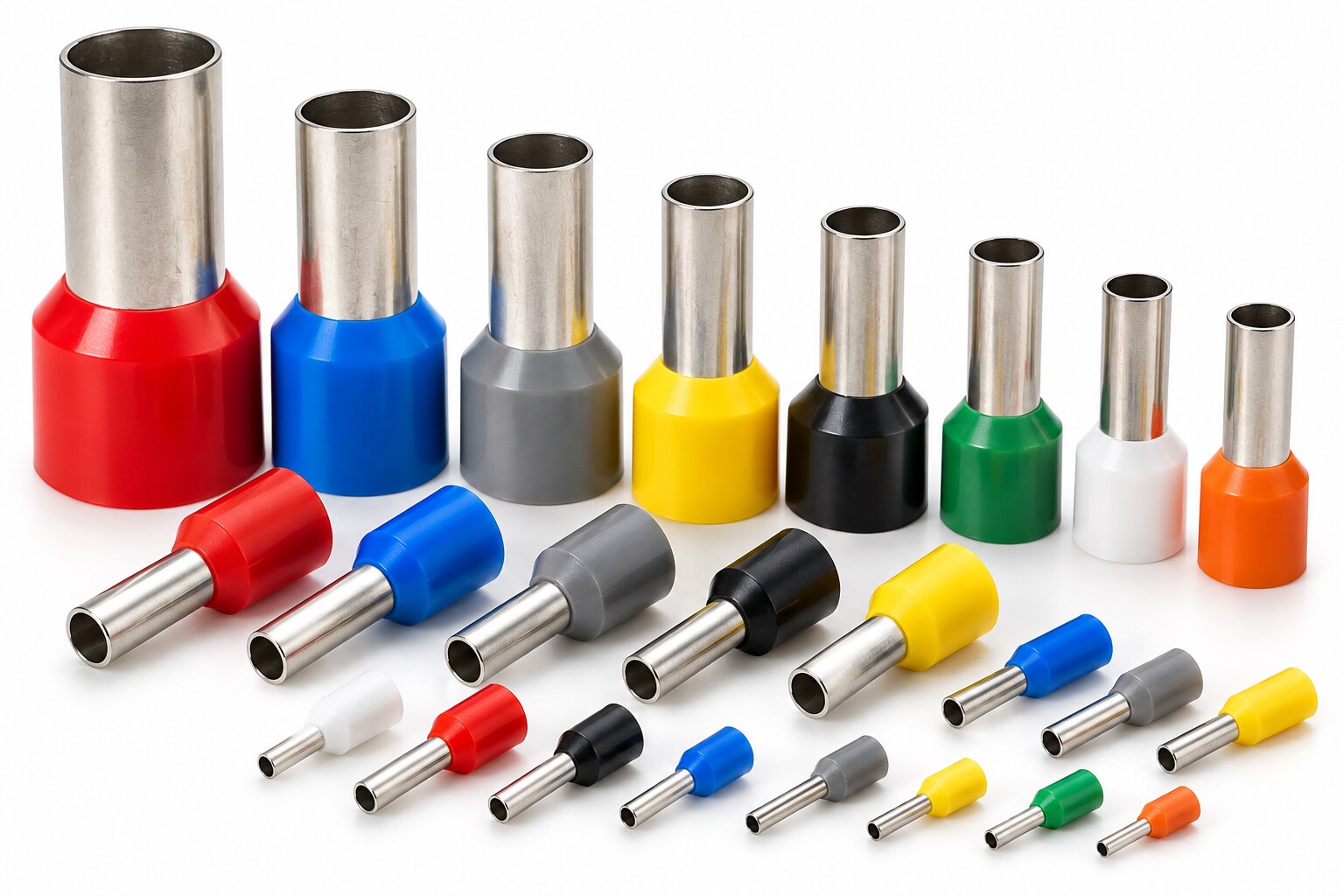
A wire ferrule is a short metal tube with an insulating collar. The stripped stranded conductor enters the barrel, and a ferrule-specific crimp compresses the tube around the strands. That gathers loose wires into one controlled end, preventing splaying, folding back, or strands being left outside the clamp.
This matters because the terminal meets a consistent surface instead of a shifting bundle. A screw terminal, spring clamp, or cage clamp is less likely to cut strands, miss them, or trap only part of the conductor. The result is more repeatable insertion and less risk of stray copper bridging an adjacent terminal.
An end sleeve ferrule is intended mainly for flexible stranded conductors, including IEC conductor classes 5 and 6. It is not a replacement for solid wire, a ring lug, or a dedicated crimp contact.
Do not insert a ferruled wire into a photovoltaic plug connector unless its manufacturer explicitly specifies that arrangement; PV connectors use an approved metal contact and contact-specific crimp.
A ferrule does not increase the wire’s permissible current or voltage rating. That limit remains controlled by:
- The conductor and ferrule material
- Crimp quality and the terminal
- The enclosure and ambient temperature
- The approved terminal system
Choose the ferrule only when the terminal permits it; its benefit is strand containment and termination consistency, not a higher electrical rating.
Which Terminals Benefit from a Ferruled Conductor
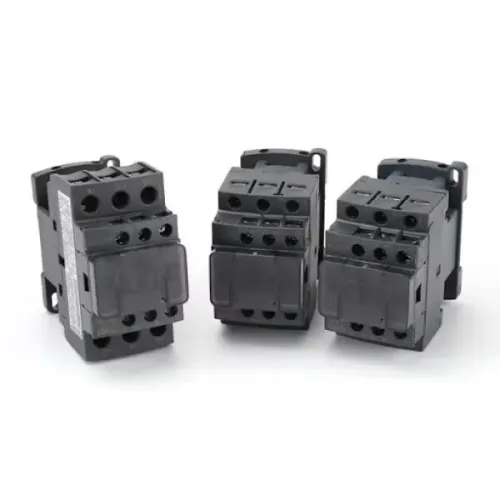
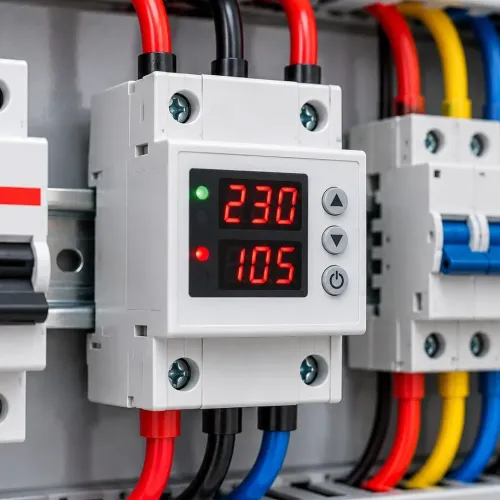
Ferruled conductors suit screw terminals, spring-clamp terminals, terminal blocks, relays, contactors, circuit-breaker accessories, control cabinets, and distribution equipment designed to accept them. A contained wire end speeds repeated installation and gives the clamp a consistent target instead of loose strands.
They are most valuable when flexible wires are inserted repeatedly, vibration or cabinet maintenance could disturb strands, or adjacent terminals leave little clearance for stray copper. A ferrule does not automatically improve every connection: check the terminal manufacturer’s wiring instructions before fitting one.
Confirm these limits in the instructions:
- Conductor cross-section and strand construction
- Ferrule barrel length and collar diameter
- Required insertion depth
- Permitted number of conductors
- Whether ferrules are allowed at all
A twin ferrule is suitable only when the terminal is rated for two conductors and the specified twin-ferrule geometry fits the entry. It is not a workaround for forcing two wires into a one-conductor terminal.
| Equipment | Why a ferruled end helps | Check before use |
|---|---|---|
| Terminal block or relay | Controls strands during repeated wiring | Clamp type, entry depth, and conductor range |
| Contactor or circuit-breaker accessory | Reduces loose-strand disturbance during maintenance | Ferrule approval and collar clearance |
| Control cabinet or distribution equipment | Limits stray copper near adjacent circuits | Terminal maker’s ferrule and tooling requirements |
Do not use a ferrule as the contact in a photovoltaic plug connector. PV connectors require their approved metal contact, specified conductor preparation, and approved crimp tool; inserting a ferruled wire can defeat the contact geometry and invalidate the connector approval.
How to Select the Correct Ferrule Size
Start with the conductor cross-section, expressed as the mm² wire size, but do not stop there. Check the ferrule marking, package label, and manufacturer’s size table against the actual strand construction and insulation outside diameter. Colour alone is unreliable because colour codes vary between manufacturers and markets.
Confirm the required stripped length, then compare the ferrule sleeve length with the terminal-entry depth. Measure the collar diameter against the terminal opening: if the collar bottoms out first, the conductive barrel may never reach the clamp.
Single ferrule and twin ferrule choices depend on the number of conductors and the terminal approval.
| Ferrule type | What it means | When it applies |
|---|---|---|
| Single ferrule | One conductor in one sleeve | One wire entering a terminal rated for one conductor |
| Twin or dual ferrule | Two conductors in one wider sleeve | Only when the terminal is rated for two conductors and accepts that ferrule geometry |
A twin ferrule is not a workaround for forcing two wires into a one-wire terminal. Confirm the ferrule material and collar limits against the operating temperature range, chemical exposure, conductor material compatibility, and terminal system approval. An oversized sleeve can remain poorly compressed; an undersized sleeve can damage strands, distort the barrel, or prevent insertion.
How to Install and Crimp an End Sleeve Ferrule Correctly
1. Set the stripped wire length to the ferrule or terminal manufacturer’s specified dimension. Use a proper stripper, and do not nick, cut, or remove conductor strands.
2. Insert every strand fully into the metal barrel. No copper should protrude beside the sleeve. Position the insulating collar at the insulation transition, keeping insulation outside the conductive crimp area.
3. Select a ferrule crimping tool with a die range and crimp profile specified for that ferrule system. A tool that fits the wire but not the ferrule can produce a convincing-looking failure.
4. Do not use ordinary pliers or side cutters. They can flatten one side, split the sleeve, damage collar ears, or leave a loose internal bundle that the terminal clamp cannot retain reliably.
5. Match the required profile exactly. A hex crimp, square crimp, trapezoidal crimp, and indent crimp are not interchangeable because each compresses the barrel and strands differently.
6. Inspect the finished termination. Check the collar for cracks or distortion, confirm the barrel is fully formed, and verify that the conductor reaches the intended insertion depth. The ferrule must not come off during reasonable manual handling.
7. For production work, add a defined pull-out test or crimp-force monitoring with an acceptance limit recorded in the work instruction.
8. Treat every crimped ferrule as single-use. Remove and replace a ferrule instead of crimping over an existing deformation; a second crimp can reduce retention and conceal damaged strands.
How to Verify Ferrule Quality Before It Enters a Panel
Treat a ferrule purchase as acceptable only when documents and trial crimps support it; appearance is not evidence. Request these records before electrical termination inspection:
| Evidence | What to verify | Reject when |
|---|---|---|
| Manufacturer size table | Ferrule marking, compatible conductor range in mm², barrel and collar dimensions | Marking and stated range conflict |
| Collar data | Material, temperature limits, chemical limits, and terminal-entry dimensions | The collar can bottom out before the conductor reaches the clamp |
| Crimp instructions | Specified die, profile, stripping length, and ferrule range | The supplier gives no compatible tooling information |
| Traceability | Batch identification on the package or production record | No batch can be linked to the sample |
| Application data | Terminal-system approval or test data for the intended terminal | Data applies to a different contact system |
Measure barrel and collar dimensions on comparison samples, then confirm that the ferrule marking matches the manufacturer size table and package label. Make trial crimps with the specified die, checking complete strand capture, full insertion depth, a clean barrel, and an undamaged collar.
The crimp must not rotate or pull off under the defined pull-out test. Hexagonal, square, trapezoidal, and indent profiles are not interchangeable. Colour alone is unreliable because coding varies between manufacturers and markets.
Yueqing Growmore Electric Co can be evaluated on technical tables, batch traceability, compatible tooling information, and answers to application questions rather than general quality claims. Choose a ferrule when the terminal permits it and you need repeatable strand containment, not as a substitute for the terminal maker’s specified contact.
Related product
 | Cable Accessories YUEQING GROWMORE ELECTRIC CO., LTD. Secure. Efficient. Long-lasting. View product → |
Frequently asked questions
What does an end sleeve ferrule change at the wire end?
It compresses loose stranded wires into one tubular end, reducing splaying, folded strands, and strands left outside the terminal clamp.
Which terminals benefit from a ferruled conductor?
Screw-clamp and spring-clamp terminal blocks, contactors, relays, circuit breakers, and other terminals designed to accept ferruled stranded conductors benefit from ferrules.
How do you select the correct ferrule size?
Match the ferrule’s conductor cross-sectional-area range to the stripped wire size, then confirm the barrel length fits the terminal and insulation collar does not enter the clamp.
How do you install and crimp an end sleeve ferrule correctly?
Strip to the specified length, insert every strand fully into the barrel, and make one complete crimp with a ferrule-specific tool in the correct size range.
How can you verify ferrule quality before it enters a panel?
Check the insulation collar, barrel, plating, dimensions, and crimp sample; reject parts with cracks, burrs, loose barrels, or incomplete compression.