Choose a cable tie by its working dimensions, material, temperature rating, exposure conditions, and installation method—not by width or the word “durable” alone. By the end, you will be able to calculate a usable tie size, compare minimum loop tensile strength, select the right nylon grade, and specify mounting and compliance evidence for the job.
Key takeaways
- Measure the widest installed bundle and choose a tie with clearance above that diameter.
- Match nylon grade and temperature rating to heat, sunlight, moisture, and chemical exposure.
- Use mounting bases or specialty ties when routing, vibration, access, or surface attachment demands them.
- Specify length, width, tensile strength, material, colour, compliance, and installation limits before ordering.
How do you choose the correct tie length, width, and strength for a bundle?
Measure the bundle diameter at its widest point with the cables arranged as they will be installed. Choose a tie whose published maximum bundle diameter exceeds that measurement with practical clearance.
Do not confuse usable length versus maximum bundle diameter: the tail must pass through the locking head, engage several pawl teeth, and leave enough material for a clean cut. A tie used at its maximum diameter is harder to tension and has less mechanical margin.
| Measure | Use the result to choose |
|---|---|
| Bundle diameter | Maximum diameter above the measured bundle, with clearance |
| Tie width | A dimensional and handling choice, not a substitute for strength |
| Minimum loop tensile strength | A rating above the bundle’s static weight, stated in newtons or pounds-force |
Minimum loop tensile strength is the standardized pull-to-failure rating of the assembled tie. Allow margin for vibration, handling, movement, and installation forces; head geometry, resin grade, molding quality, and moisture conditioning also affect performance. Ask whether the rating was measured on dry or conditioned ties.
For production work, use a tensioning tool set to the manufacturer’s specified range. Excessive tension can indent insulation, crush shielded or fiber-optic cables, and reduce bend or crush margin; insufficient tension allows movement and fretting. Cut the tail flush without leaving a sharp edge.
Which nylon grade and temperature rating fit the installation environment?
Choose the resin and exposure before choosing the color. Most cable ties use polyamide 6.6, or PA66, also called standard nylon 6/6. PA66 absorbs moisture, which increases flexibility and changes dimensions, stiffness, and tensile behavior, so request mechanical data measured after conditioning that matches storage and service.
| Grade | Exposure | Selection |
|---|---|---|
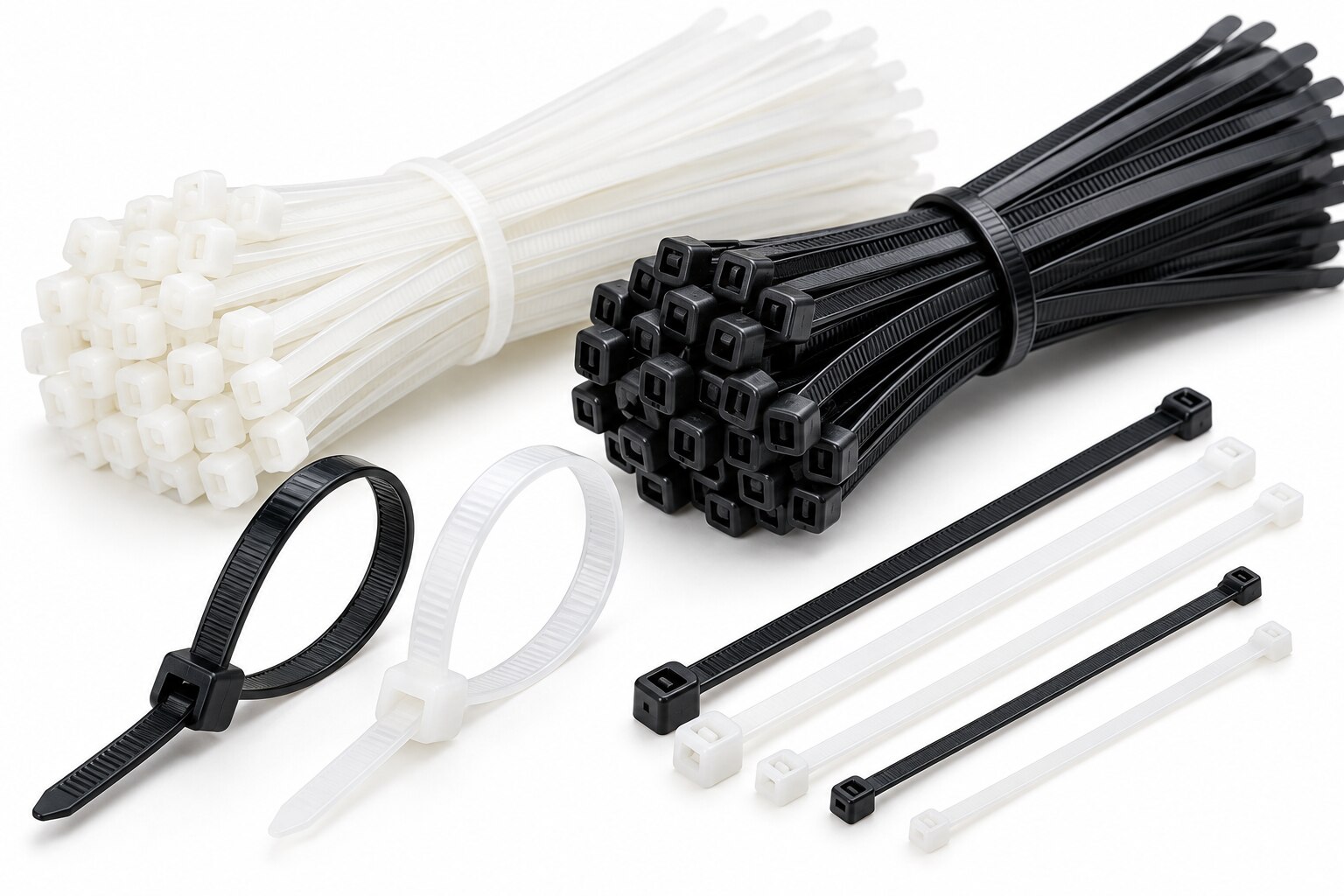
| Natural white nylon | Protected indoor wiring without sustained heat or sunlight | Use when UV resistance is not required |
| UV-stabilised black nylon | Rooftops, photovoltaic arrays, poles, vehicle exteriors, and prolonged sunlight | Require an explicit UV or outdoor qualification; black color alone proves nothing |
| Heat-stabilised PA66 | Hot equipment or conductors | Use only when the datasheet supports the required temperature |
Natural white nylon versus black nylon UV resistance is not a color choice: the black grade needs a stated formulation or test classification for outdoor service. For photovoltaic wiring, also prevent water-trapping loops and contact with hot surfaces.
Check four separate figures before approval:
- Continuous operating temperature
- Short-term exposure temperature
- Installation temperature
- Temperature used for the strength test
Standard PA66 ties are commonly offered around -40 °C to 85 °C continuous service. Heat-stabilised grades may cover about 105–125 °C, but compounds differ between suppliers.
Cold-rated service does not guarantee cold installation. Below freezing, sharply bending, forcing the locking head, or cutting the tie can crack nylon. Obtain cold-weather installation instructions for outdoor work.
When should you use a special tie or mounting base instead of a standard one-piece tie?
A standard one-piece tie is the wrong choice when the bundle needs repeated access, a defined routing path, or attachment to a fixed surface.
| Option | Main advantage | Check before use |
|---|---|---|
| Releasable cable ties | Repeated opening during planned maintenance | Require a stated tensile rating; the release feature can enlarge the head, reduce strength, weaken vibration resistance, or allow accidental release |
| Push-mount cable ties | Fastening through prepared holes in panels, control cabinets, or vehicle structures | Verify hole diameter, panel thickness, retention force, and clearance behind the panel |
| Marker ties | Identifying circuits without a separate label | Confirm that the marking area remains visible after installation |
| Bead ties and ladder ties | Adjustable harnesses, repeated bundling, and re-entry | Check spacing, locking method, and pressure on insulation |
| Parallel-entry ties | Routing two adjacent bundles or keeping conductors aligned | Ensure the head does not press against insulation or a bend transition |
| Mechanical bases | Fixed attachment on panels, trays, poles, or high-vibration locations | Confirm that drilling is permitted and select screw-mounted, riveted, or equivalent hardware |
Adhesive-backed mounts need a clean, dry, compatible surface. Heat, UV, dust, condensation, and plasticizer migration can release the pad while the nylon remains intact, so use a qualified mechanical base outdoors, in hot or vibrating areas, or in safety-critical work.
Do not drill into a sealed enclosure, structural member, conduit, or equipment containing hidden wiring without approval. Keep every tie clear of seals, connector backshells, sharp edges, and cable bend transitions. Use a listed clamp instead where the cable is suspended, repeatedly flexed, or exposed to pull.
How do you check exposure, compliance, and installation limits before using nylon?
1. Match the tie to the complete environment, not merely indoor versus outdoor exposure. Record sunlight, moisture, oil, cleaning agents, chemicals, vibration and abrasion resistance, plus heat from adjacent conductors or equipment. Ask for evidence behind each claim: a datasheet, test classification, or certificate with the applicable conditions.
2. Verify chemical compatibility with the actual cable jacket and process chemicals. PA66 tolerates many oils and greases, but concentrated mineral acids, strong alkalis, phenolic compounds, and some solvents can attack or embrittle it. A tie that survives in air can fail early in a battery room or industrial-cleaning process.
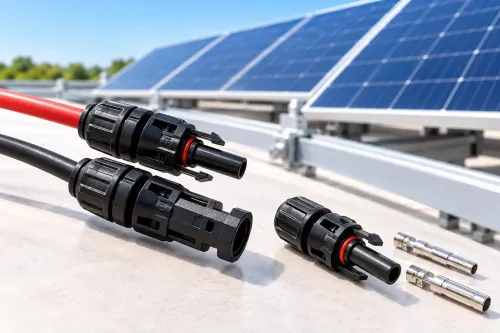
3. For photovoltaic wiring, require explicit outdoor and UV qualification. Avoid loops that trap water, keep the tie from rubbing the jacket, and prevent it from resting against a hot surface.
Follow the applicable electrical code or array-installation standard for support intervals; never use a tie to carry module or equipment loads unless the system is designed and listed for that purpose. Preserve the cable manufacturer’s minimum bend radius, and use a listed clamp for suspended, repeatedly flexed, or pulled cable.
4. Check IEC 62275 and UL 62275 for the applicable edition, tie type, minimum loop tensile-strength class, temperature range, UV requirements, markings, and traceability. UL 94 alone does not prove plenum, railway, photovoltaic, low-smoke, or halogen-free suitability. Name the required installation standard and certificate in the purchase specification.
How do you turn the selection into a purchase specification?
Write the cable tie purchase specification with pass/fail fields, not adjectives. State the bundle diameter range, tie length, minimum loop tensile strength in N or lbf, PA66 grade, color, continuous and short-term temperature limits, installation-temperature limits, and the moisture-conditioning basis for mechanical data.
- Require the UV classification for exposed work, named chemical exposures, mounting method, head orientation, tool tension range, flush-cut requirement, and batch traceability.
- Require dimensional drawings showing maximum bundle diameter and head dimensions; a catalog width is not enough.
- Inspect every incoming pack for the part number, resin or grade, production lot, temperature and UV claims, and the applicable edition and documentation for IEC 62275 or UL 62275.
- Reject packs with missing markings, inconsistent dimensions, unverified claims, or no lot record.
Use this comparison when polymer limits are exceeded:
| Option | Specify and verify | Main extra risk |
|---|---|---|
| Nylon PA66 | Moisture-conditioned tensile data, UV classification, chemical compatibility, installation temperature | Embrittlement, softening, or strength change outside the stated limits |
| Uncoated stainless steel | Grade, dimensions, loop strength, locking-head design, and cutting method | Galvanic interaction, jacket damage, difficult field cutting, and chloride corrosion |
| Coated stainless steel | Coating type, temperature limit, chemical resistance, and edge protection | Coating failure above its temperature or chemical limit |
Yueqing Growmore Electric Co is worth considering only if it supplies these drawings, conditioning data, certificates, and batch traceability with the tie; “reliable,” “durable,” and “versatile” are not acceptance criteria.
Related products
 | Cable Accessories by YUEQING GROWMORE ELECTRIC CO., LTD. Reliable. Durable. Versatile. YUEQING GROWMORE ELECTRIC CO., LTD. View product → |
 | Cable Accessories STEEL TIES ( COATED & UNCOATED ) Steel Ties (Coated & Uncoated) YUEQING GROWMORE ELECTRIC CO., LTD. Strength. Safety. Security. View product → |
Frequently asked questions
How do you choose the correct tie length, width, and strength for a bundle?
Measure the bundle at its widest point in its installed arrangement. Choose a published maximum bundle diameter larger than that measurement, then select width and tensile strength for the bundle size, weight, movement, and support needs.
Which nylon grade and temperature rating fit the installation environment?
Check whether the installation needs standard nylon 6/6, UV-stabilized nylon for sunlight, or heat-stabilized nylon for elevated temperatures. Compare the manufacturer’s temperature range with the lowest and highest temperatures at the installation site.
When should you use a special tie or mounting base instead of a standard one-piece tie?
Use a mounting base when cables must attach to a panel or surface. Choose releasable, push-mount, marker, bead, or stainless-steel ties when access, identification, preassembled holes, vibration, or harsh exposure makes a standard tie unsuitable.
How do you check exposure, compliance, and installation limits before using nylon?
Review the datasheet for UV resistance, chemical compatibility, flammability rating, temperature range, tensile strength, minimum installation temperature, and the approved tightening or tool limits. Confirm the stated compliance marks match your project requirements.
How do you turn the selection into a purchase specification?
State the tie length, width, maximum bundle diameter, minimum loop tensile strength, nylon grade, colour, temperature range, UV or chemical resistance, mounting style, compliance requirement, packaging, and installation-tool limits.